
The Delft Bell test, rebuilt as a mechanism
In 2015 two electron spins in diamond, 1.3 kilometres apart, broke Bell's limit with no loopholes. These pages rebuild that experiment from a simple physical mechanism, so you can run it, change the settings and see the result for yourself.
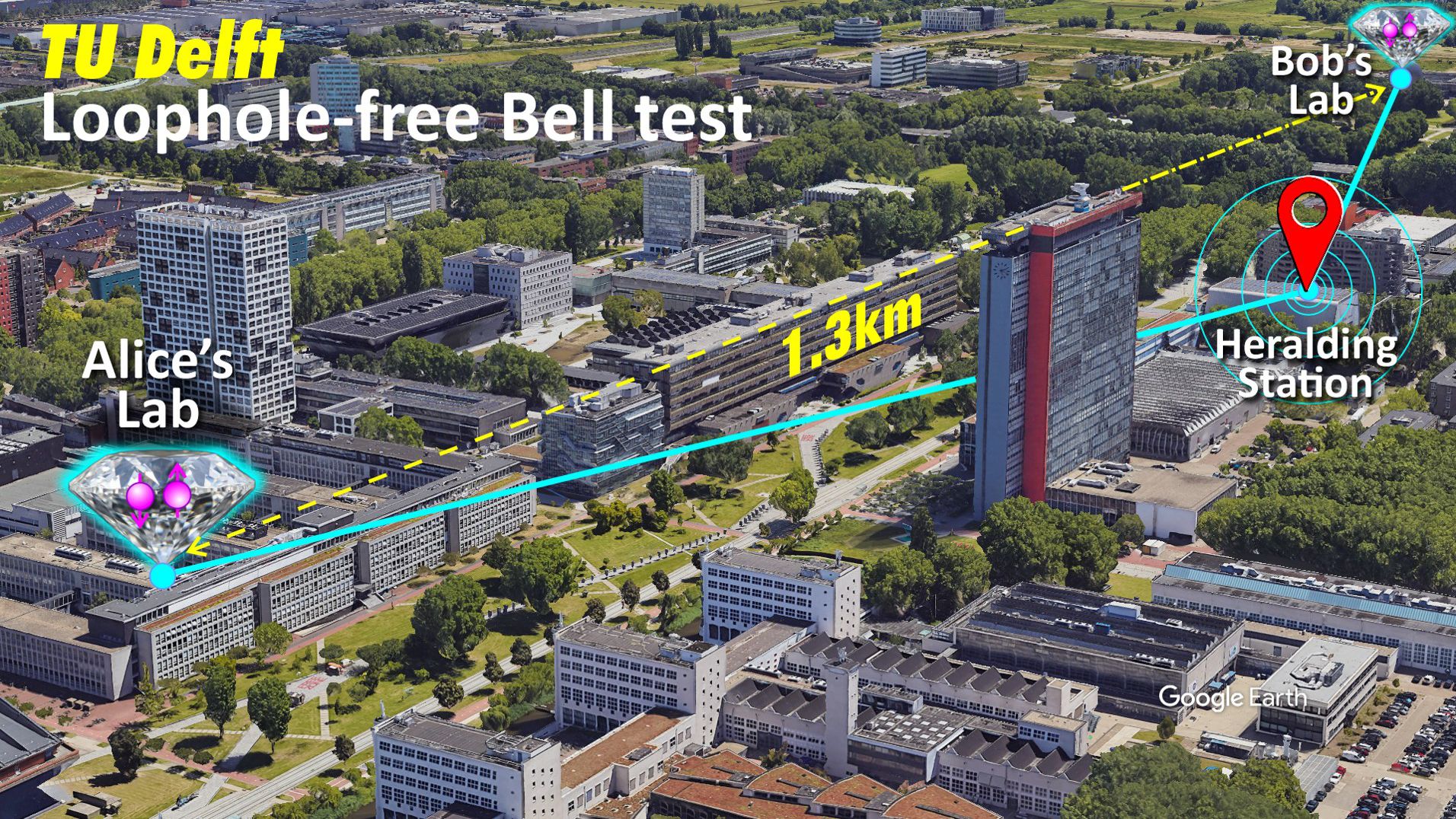
In 2015 a team at TU Delft ran a Bell test with electron spins in two diamonds, 1.3 kilometres apart. A heralding station between the labs signalled each entangled pair, and each lab chose its measurement angle at random and recorded its reading before any light signal could cross between them. The result, S = 2.42 ± 0.20, was above Bell's limit of 2, with no loopholes.
We have rebuilt that experiment from the Liquid Gravity Atomic (LGA) model, one step at a time. A shared medium links the pair. It makes one draw around the primary lab's angle, and the secondary lab flips its result with a chance set by the gap between the two angles. Over many runs this gives S = 2.83, while each lab's own record stays 50:50. The Delft value is lower because of the readout and state imperfections the Delft team report themselves. The link is super-local: it acts by contact through the medium, but faster than light.
The interactive models below let you run the experiment with your own settings. Change the hidden plane and the angles, step through a single run or run thousands, and watch the score settle.
Start here
Follow the experiment from the lab bench to the statistics.
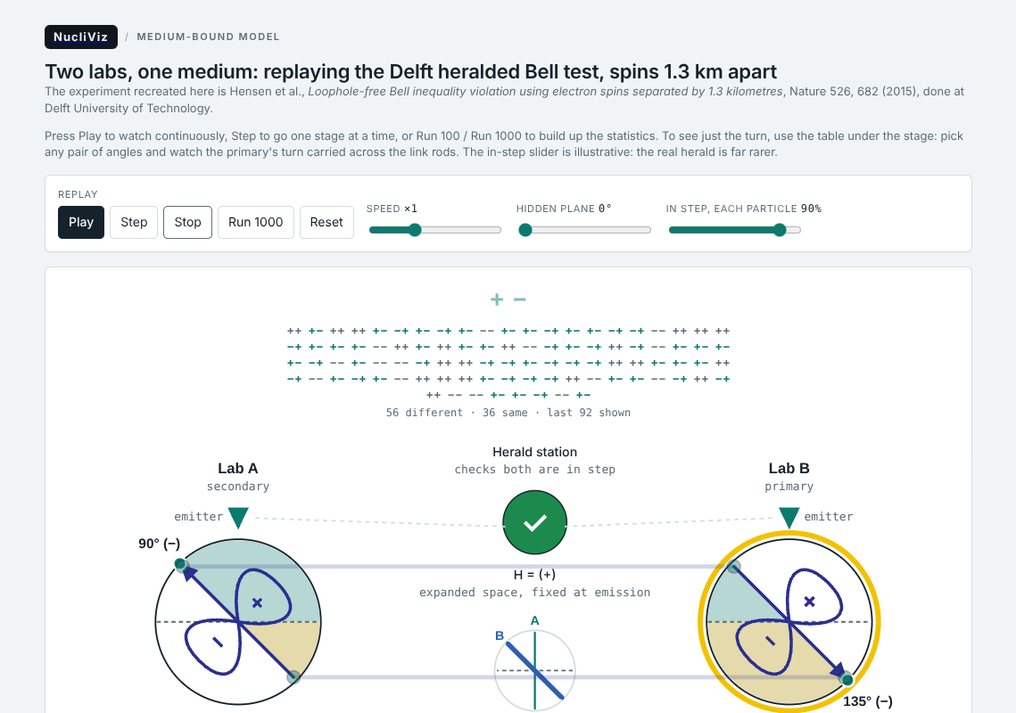 Herald Replay: the Delft test, step by step →Watch the whole experiment one stage at a time: the pair is emitted, the herald confirms it, each lab turns its setting and reads out. Step through it or run hundreds of trials.
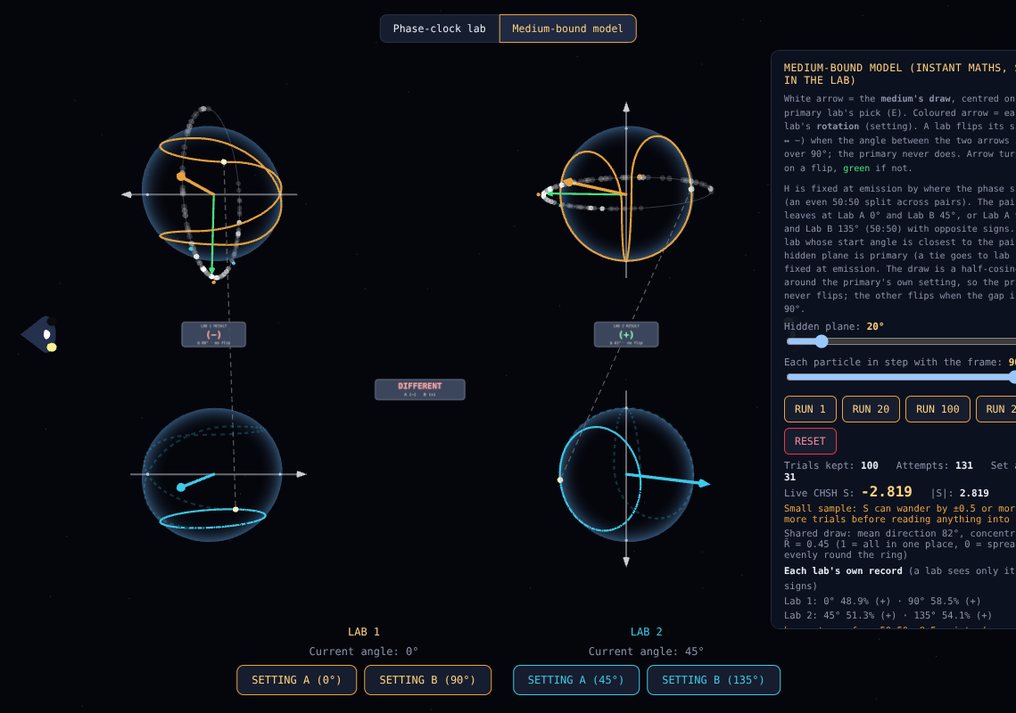 Two-Lab Test Rig →Two labs, two electrons and a live CHSH score. Change the hidden plane and the angles, run up to 2,000 trials and watch S settle near 2.8.
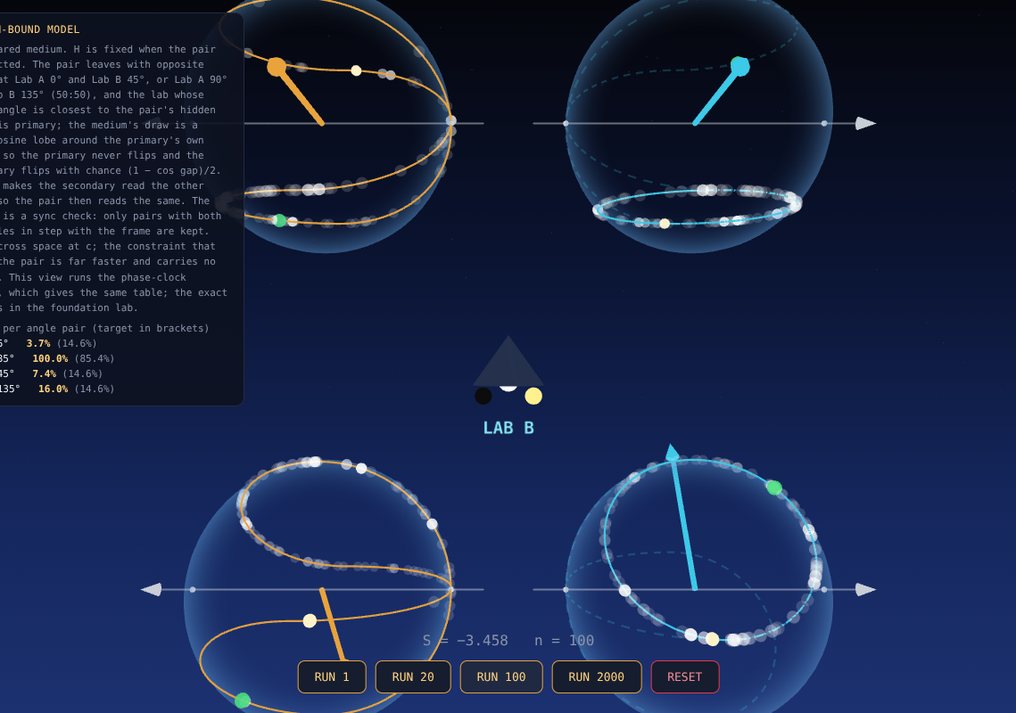 Clean Presentation Mode →The same rig stripped back to the electron pair, the ghost dots and the live CHSH number.
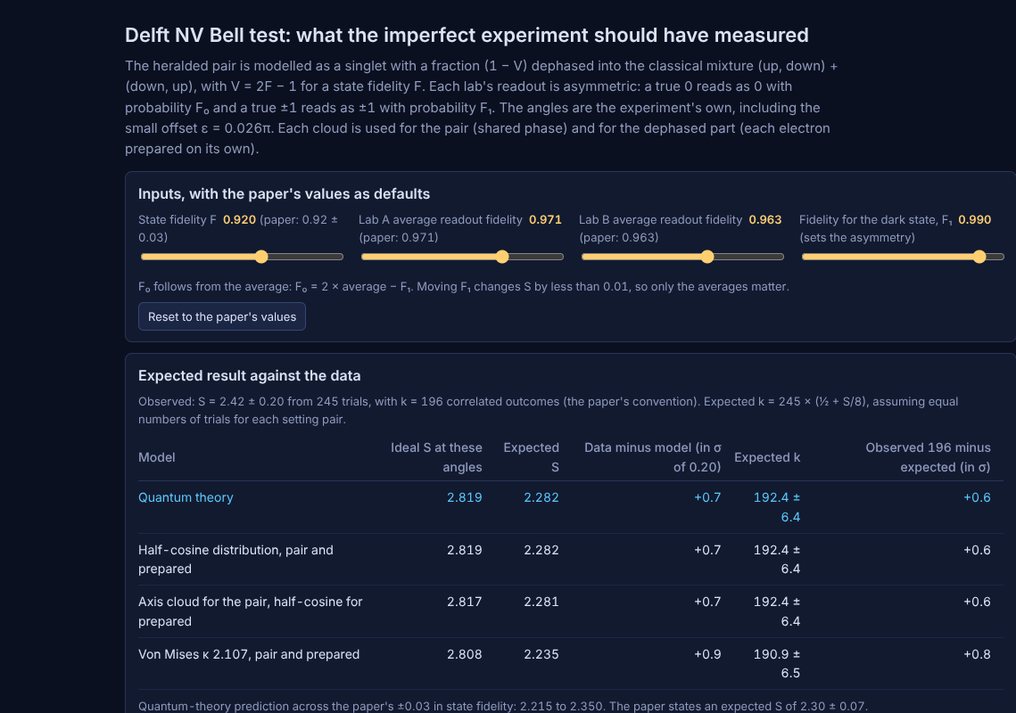 What the real experiment should have measured →Rebuilds the expected outcome of the Delft test from its own published fidelities. Adjust them and compare with the data.
Inside the diamond
How the NV-centre electron spins behave, and how the model reproduces them.
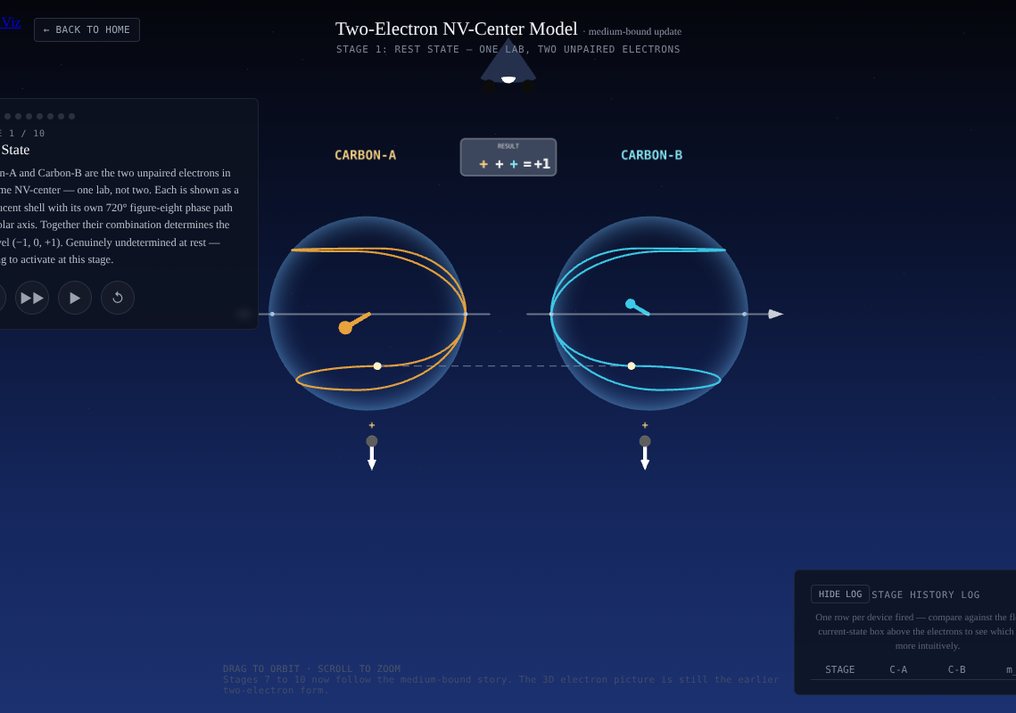 Two-Electron NV-Centre Model →A stage-by-stage walkthrough of the diamond Bell test, from the green-laser reset through microwave rotation, photon emission and readout.
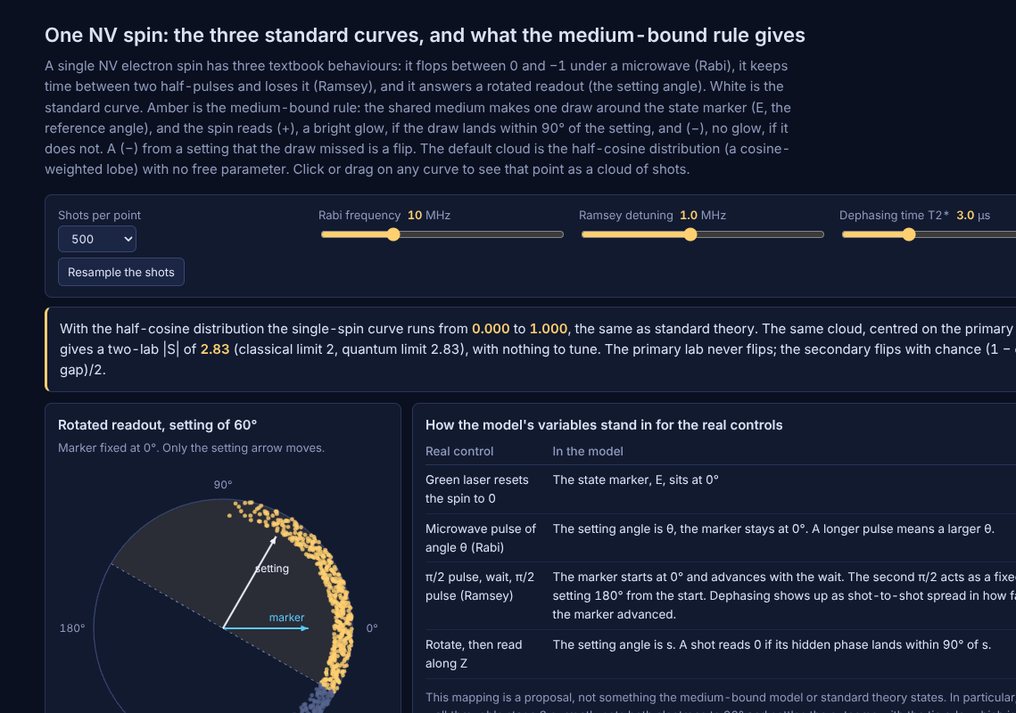 One NV Spin: the three standard curves →Rabi oscillations, Ramsey fringes and rotated readout, compared with the model's own rule, with the hidden phase drawn as a cloud of shots.
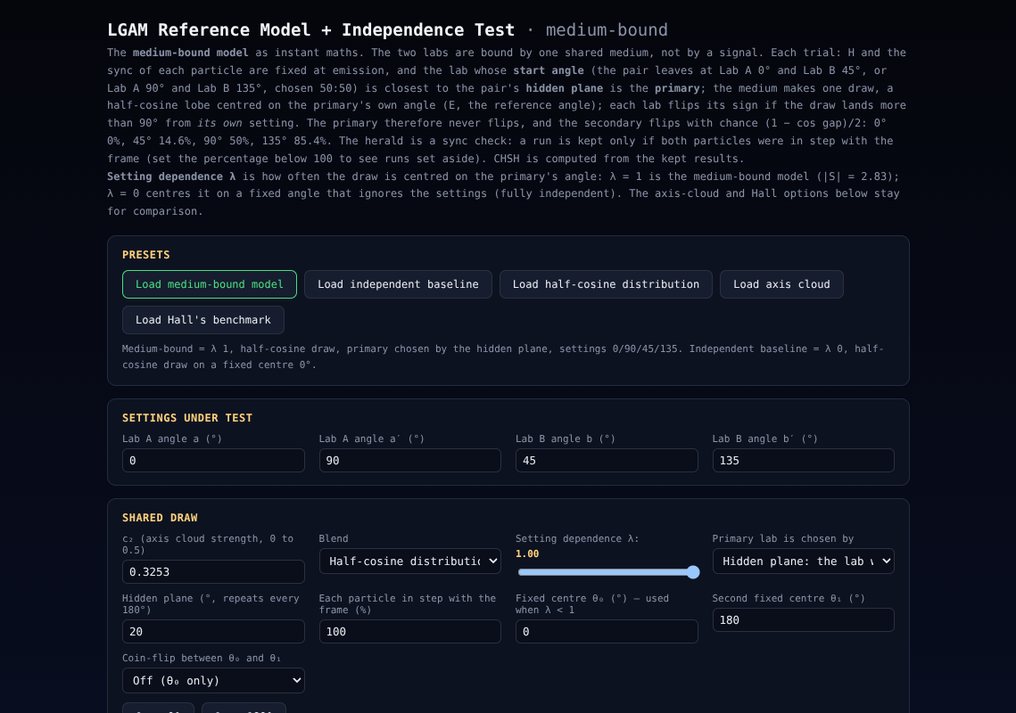 Reference Model and Independence Test →Instant-maths comparisons between the model and alternatives, including a minimal-dependence benchmark and a repeat-setting test.
Ideas and comparisons
Build the intuition, then see where the model sits among the alternatives.
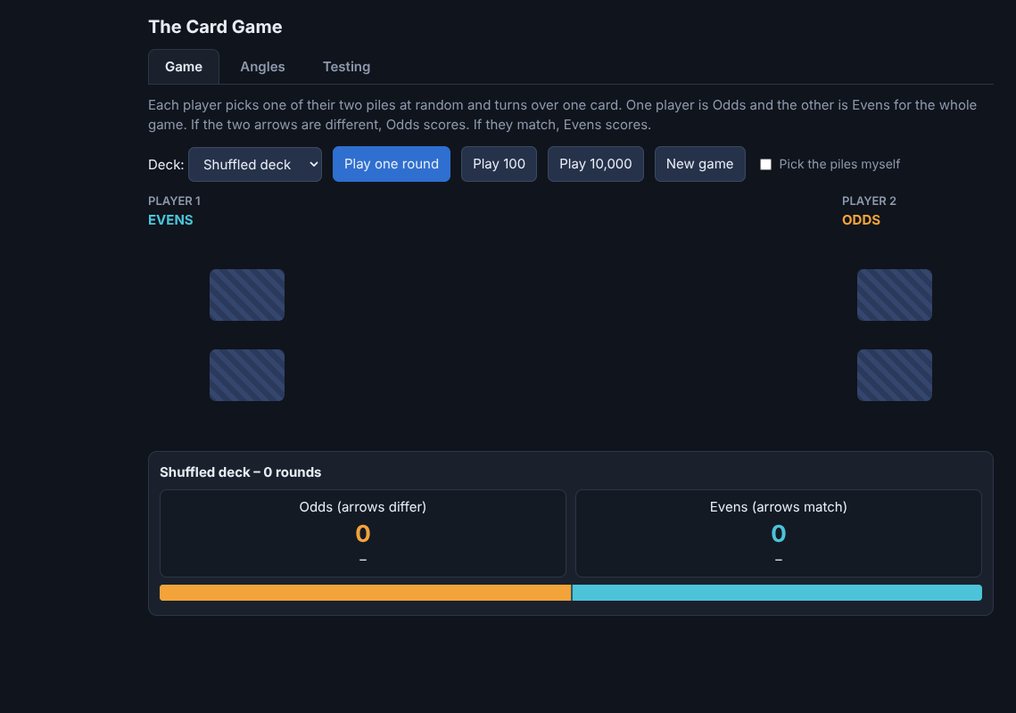 The Card Game →A deck of cards that reproduces the Bell statistics. Play a round, then 10,000, and see how a shared hidden property can give the "magic" result.
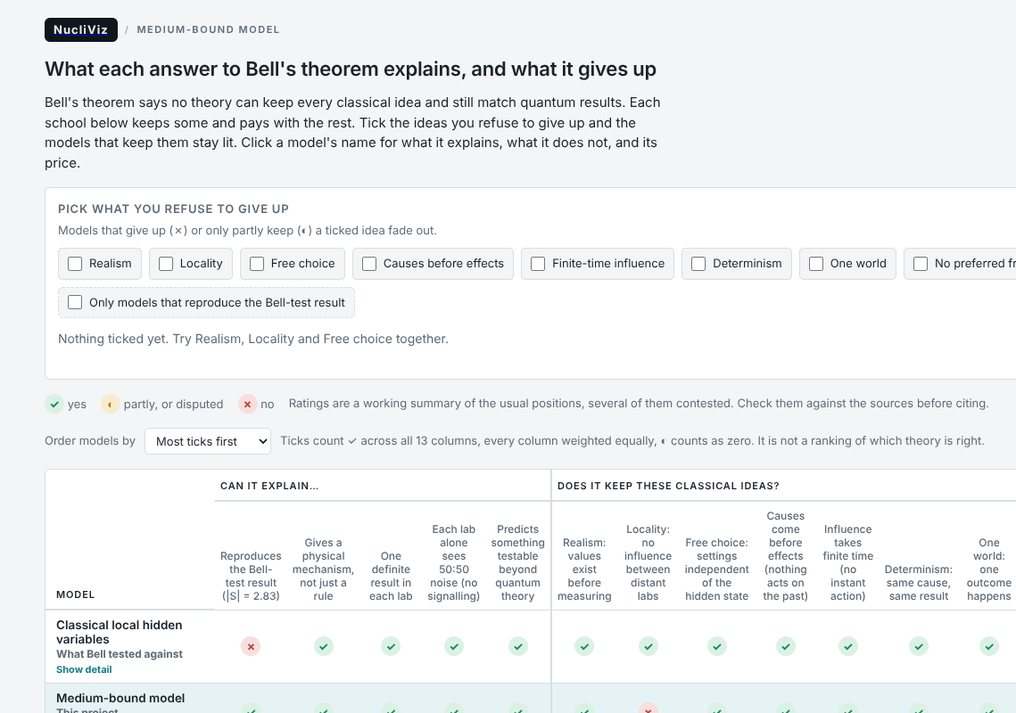 Bell Solutions Matrix →What each answer to Bell's theorem explains, and what it gives up, side by side. Tick the ideas you refuse to give up.
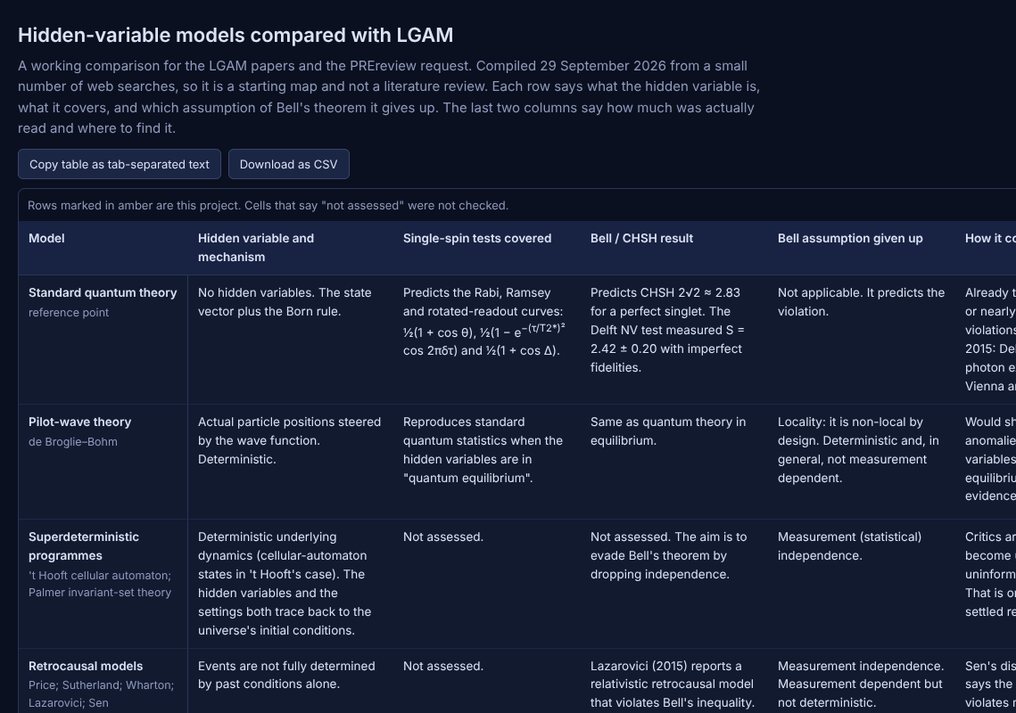 Comparison with other hidden-variable models →A sourced table against pilot-wave theory, superdeterminism, retrocausal models and other published approaches.